
What Allegan County Deed Records Show
The Register of Deeds receives every land instrument and keeps it on record permanently. A deed itself names the parties, the recording references, and the described land, while related instruments explain financing, releases, restrictions, authority, and later events.
| Deed Type | What It Does | Common Use |
|---|---|---|
| Warranty deed | Conveys the stated interest with covenants | Ordinary sale trail |
| Quitclaim deed | Conveys whatever interest the grantor has | Family or title cleanup transfers |
| Trustee or representative deed | Conveys through stated fiduciary authority | Trust or estate transfer |
| Sheriff's deed | Records a foreclosure-related conveyance | Chronology with court and redemption records |
| Tax-related deed | Records a transfer after the statutory process | Compare with Treasurer sale status |
Liens, mortgages, assignments, easements, land contracts, powers of attorney, trust certificates, releases, and plats all sit in the same broader land-record trail. A lien is not a deed. It burdens an interest rather than conveying ownership, so read the two kinds of instruments differently when tracing title.
Enter Kofile Through Login as Public
The county links its Kofile Register Online Services portal, and public users enter through "Login as Public."
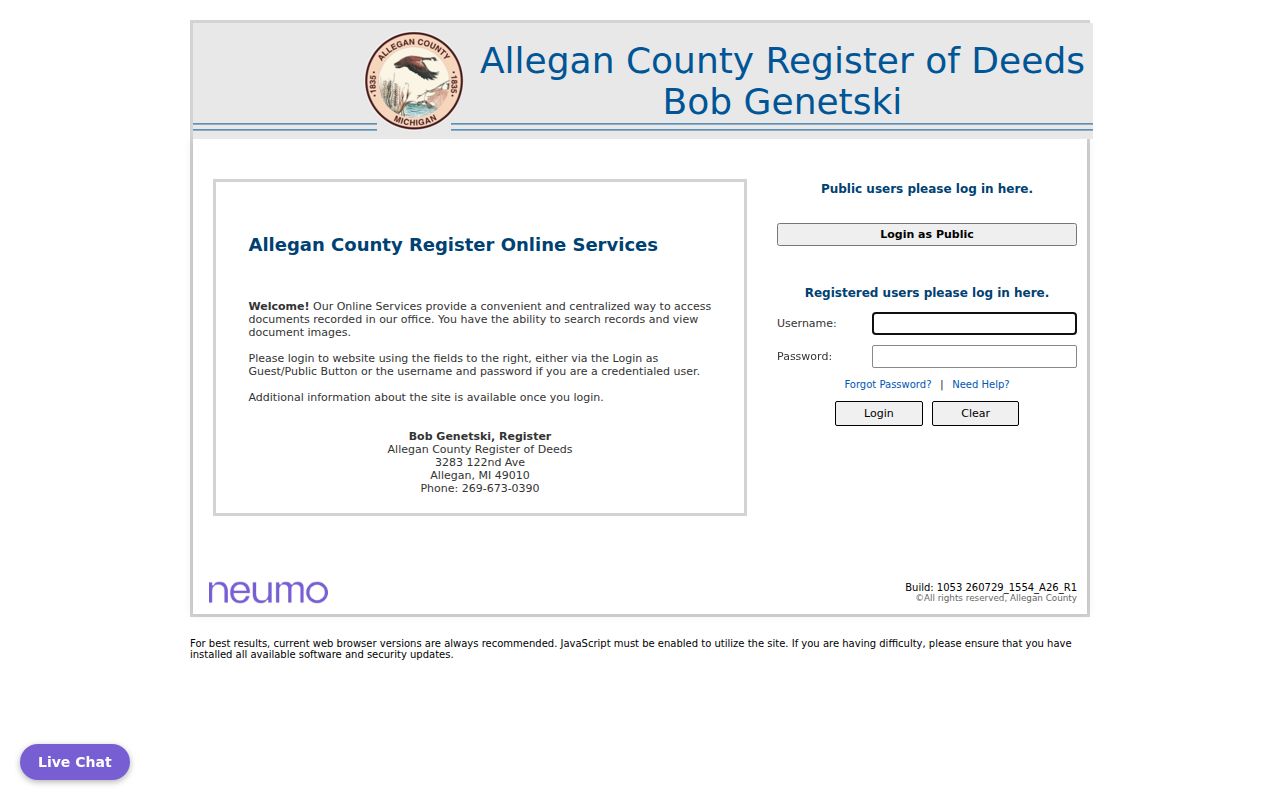
The county's official entry page identifies the correct portal. The live public session controls current search and image options. Expect some trial and error. The pre-login screen shows no field labels, no image pricing, and no oldest indexed year. A failed name query proves nothing. Search spelling variants. Try roles, document types, and a broad date span around a known sale.
Start from the owner or taxpayer name in the county-linked BSA search. Pull legal-description clues from there too. For an entity or trust, keep the name exactly as recorded. One reference opens the next. A deed may cite a prior instrument, book/page, plat, master deed, or amendment. Use that reference as your next key.
More Than 200 Document Types Cross the Index
The county's 2022 annual report notes more than 200 legal-document types. All of them cross the Register of Deeds counter. So look past "deed." A mortgage, assignment, satisfaction, tax lien, judgment lien, easement, restrictive covenant, land contract, sheriff's deed, redemption certificate, power of attorney, or trust certificate may hold the answer. So may a modification. Watch releases closely. A separately indexed release can sit under a successor lender or trustee name.
| Index clue | Party name, document type, recording date, instrument or book/page |
|---|---|
| Property clue | Legal description, plat, lot/block, master deed, parcel reference |
| Status clue | Assignment, modification, release, satisfaction, redemption, later deed |
Note: An unreleased-looking index hit may have a separately indexed satisfaction; read the chronology before characterizing its status.
Follow Allegan County's Grantor-Grantee Trail
The grantor transfers the stated interest. The grantee receives it, so build the chain from actual instruments while keeping execution and recording dates distinct.
- Find the current owner's acquiring deed with that party as grantee.
- Read the grantor and the cited prior reference from the image.
- Search that grantor as an earlier grantee and confirm the same legal description.
- Repeat, moving to deed books, microfilm, or ROD reference help when online coverage ends.
- Grantor
- The party transferring the stated interest.
- Grantee
- The party receiving it.
- Chain of title
- The chronological sequence of conveyances affecting the same land.
- Book/page or instrument number
- The recorder's retrieval reference for a filed document.
When the Online Deed Index Ends
The county does not state the precise earliest online year. Its 2022 annual report calls that year the third full year of a new records system. A searchable database was part of that system. That hints at a rollout near 2019, not an imaging cutoff. Older ownership needs a fallback. Try ROD counter and reference help, deed books, and microfilm. Recorded plats, archived 2021 rural platbooks, the Archives of Michigan, and local library collections also help.
The county dates to 1835. It was set off in 1833. Older descriptions may use township territory predating a modern city boundary. Library newspapers, directories, and indexes are leads. Confirm each claimed transfer in the recorded instrument itself.
Recording Volume Gives Context, Not Coverage
County reports list 24,019 recordings in 2022, 19,011 in 2023, and 19,302 in 2024, with a 2021 high of 31,015. Volume describes workload, nothing more. It says nothing about the first online deed year or the completeness of a particular chain. Save the portal retrieval date. Vendor screens and indexed content can change.
Monitor Names with Property Fraud Alert
Property Fraud Alert went countywide in October 2022. The 2024 taxpayer letter reported 3,363 enrolled property holders. The service matches names and sends alerts. It does not block a filing. It also cannot watch one parcel exclusively, validate title, or prove fraud. Treat any match as a cue to inspect the instrument and call the Register of Deeds.
Connect Estate Transfers to Probate Records
A deed signed by a personal representative, trustee, or heir may make sense only beside an estate file. Probate belongs to a different office. The Allegan County Probate Court handles deceased estates and trusts, while recorded deeds and authority instruments stay in the ROD trail. Search the decedent's exact name. Compare case dates and recording dates. Match the legal description rather than trusting a shared family surname.
The county's small-estate transfer-by-affidavit route excludes any estate containing real property. That matters when land is involved. The formal or informal deceased-estate process, the will or appointment record, and the eventual conveyance carry the weight instead. Obituaries, cemetery references, and library directories can suggest relationships. They never replace the probate file and the deed.
Read Liens and Releases as Pairs
For a mortgage, capture the borrower, lender, recording date, reference number, legal description, and any principal amount shown. Then hunt the pair. Search assignments, modifications, partial releases, satisfactions, and discharges under successor lender or trustee names. Judgment, construction, state, federal, and MESC liens deserve the same chronology. An index label only says an instrument was recorded. It never decides whether the claim still binds.
Easements can hide in many places. Look for them in a deed, a separate instrument, a recorded plat, a condominium master deed, a declaration, a covenant, or a survey exhibit. When shared access, drainage, utilities, or shoreline rights matter, search parent and neighboring parcel references too. A road line on GIS proves no recorded easement.
Preserve Three Dates for Every Allegan Deed
Record three dates in separate fields for every Allegan County deed. These are execution, recording, and assessment-roll entry. A deed can be signed in December. It can then be recorded in January and reach the tax roll a cycle later. So the names may disagree while every source stays correct. Keep the document type and indexed parties. Also keep the book and page or instrument number, the legal description, and the date you retrieved the source. That discipline makes a chain auditable in reverse.
Test Entity Authority Without Assuming Ownership
An LLC or corporation in an Allegan County deed index needs its own paper trail. Compare the exact legal name against Michigan LARA's business registry and its filing history. The MiBusiness Registry Portal launched June 23, 2025. Older COFS guides still teach search concepts but no longer match the current screen. A registered agent is only a cross-reference. It is not automatically the signer or the parcel's owner of record.
Search the deed records for authority documents when a signature needs explaining: a power of attorney, certificate of trust, trustee affidavit, merger filing, or successor instrument. Match the dates and legal descriptions against the deed itself. Entity filings prove identity and good standing. Only the recorded deed and its companion authority documents show what was actually presented to the recorder.
Use Plats and Master Deeds as Chain Keys
An Allegan County deed might describe land by subdivision, lot and block, or metes and bounds. It might also cite a condominium unit. Pull the recorded plat whenever a deed cites one. Note its dedications, easements, amendments, and any replats. A condominium parcel search often demands both the unit deed and the master deed. Common elements and unit boundaries simply are not standalone tax lots.
The county's archived 2021 rural platbooks can still generate leads on older owners and road names. The county treats them as historical references only. Check every lead against the recorded deed or plat before relying on it. Michigan LARA offers a subdivision-plat route for final plats recorded from 2019 onward. For the recorded land-document trail itself, the Register of Deeds remains the county source.
Suppose the GIS map geometry and the deed wording clash. Preserve the discrepancy instead of picking whichever source looks tidier. Roads, shoreline changes, parcel splits, and parent tracts all breed apparent conflicts. A recorded legal description carries authority a tax-map polygon never will.
A reproducible chain also logs every referenced amendment and easement number. That lets another researcher follow the same branch without trusting a summary.
Get an Allegan County Deed Copy
Start with the portal image when one exists. Otherwise order a plain or certified copy from the Register of Deeds. The official county fee schedule lists $1 per page for copies. Plat or plan copies run $0.20 per page. A real-estate-specific document search costs $2 per name. A state or federal lien certificate search runs $5 per name. Confirm current charges, certification, delivery, and payment options before ordering.
The office keeps the permanent image rather than the original instrument. It does not draft legal documents or give legal advice. Give the staff party names, document type, and an approximate recording date. Include an instrument or book/page reference and the legal description. That makes any office or mail request far more precise.
Recorded, not guaranteed. Allegan County deed records show filed instruments, not a title opinion; unrecorded interests and unresolved defects can exist.